


What does GR/IR mean?
GR/IR stands for:
GR = Goods Receipt
IR = Invoice Receipt
It is a temporary account used when:
the goods arrive first,
but the supplier invoice arrives later.
Or the other way around.
This happens all the time in real business.
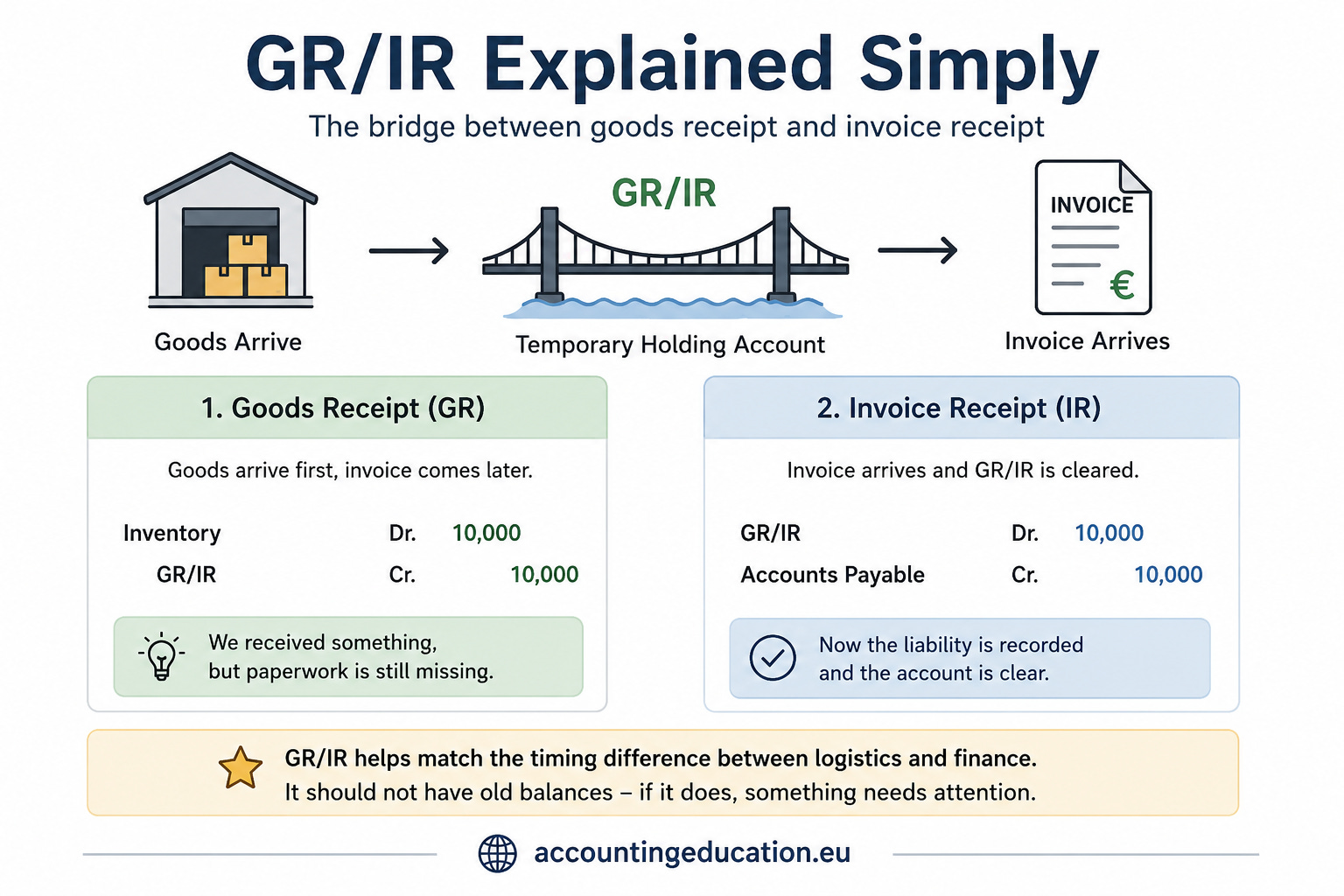
A simple real-life example
Imagine your company orders frozen chicken from Thailand for €10,000.
The goods arrive on 28 March.
But the supplier invoice only arrives on 3 April.
Now accounting has a problem:
Operations say:
“We already received the goods.”Accounting says:
“Okay… but where is the invoice?”
This is where GR/IR comes in.
Step 1 — Goods Receipt (GR)
When the warehouse confirms the delivery in SAP, the system posts something like this:
Debit Inventory €10,000
Credit GR/IR €10,000
What does this mean?
Inventory increases because the goods physically arrived.
But we still do not have the supplier invoice.
So instead of posting Accounts Payable immediately, SAP parks the amount in GR/IR temporarily.
Think of GR/IR as:
“We received something, but paperwork is still missing.”
Step 2 — Invoice Receipt (IR)
A few days later, the supplier invoice arrives.
SAP posts:
Debit GR/IR €10,000
Credit Accounts Payable €10,000
Now:
the GR/IR account clears,
and the supplier liability is officially recorded.
Why do companies use GR/IR?
Without GR/IR, month-end accounting would become messy very quickly.
Companies need:
inventory to be correct,
liabilities to be correct,
and expenses to be recorded in the proper period.
GR/IR helps match:
physical movement of goods,
with financial documents.
It is basically an accounting bridge between logistics and finance.
Why accountants reconcile GR/IR
This is the important part.
The GR/IR account should usually clear itself.
But in reality, things go wrong all the time:
invoices never arrive,
wrong quantities are invoiced,
duplicate invoices happen,
goods were returned,
purchasing orders were incorrect,
exchange rate differences appear,
somebody forgot to post something in SAP.
This is why accountants review GR/IR balances during month-end close.
If old balances stay there for months, it usually means:
“Something in the process is broken.”
Example of a GR/IR issue
Let’s say:
Goods received: €10,000
Invoice received: €9,500
Now GR/IR still has €500 remaining.
Accounting needs to investigate:
Was the invoice wrong?
Was delivery incomplete?
Was there a pricing issue?
Was freight missing?
This is why GR/IR reconciliations are so important.
Is GR/IR an asset or a liability?
This confuses many beginners.
The answer is:
It can behave like both.
Credit balances often represent goods received but not invoiced yet.
Debit balances may represent invoices received before goods arrived.
That’s why many companies present GR/IR separately during reconciliation reviews.
The easiest way to understand GR/IR
Forget the technical SAP language.
Just remember this:
GR/IR is a temporary holding account used when goods and invoices arrive at different times.
That’s it.
Once both sides are posted correctly:
the account should clear,
and everybody is happy.
Well… at least until month-end starts again.